Founder Spotlight: Dr. Assia Kasdi, Milvus Advanced
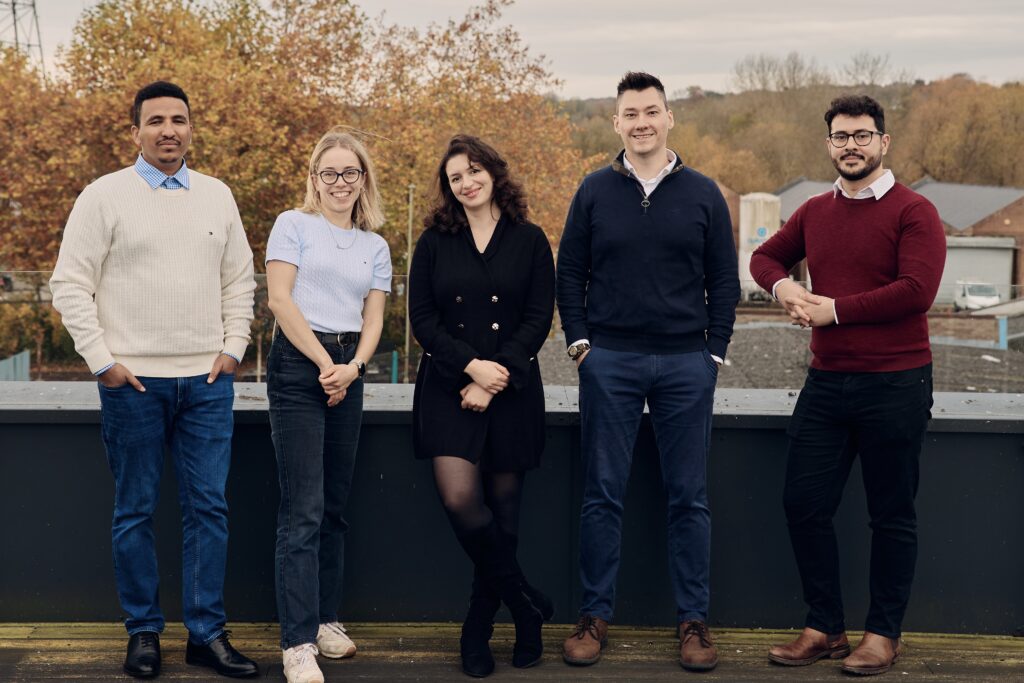
Milvus Advanced Founder and CEO Assia Kasdi (Center), joined by (left to right) R&D Lead Gebrehiwet Abrham Gebreslase, Electrochemist Dorottya Szalay, CFO Eduardo Paperini, and Senior Scientist Mario Falsaperna.
What led you to found your company?
Assia: I’ve always been fascinated by the way materials shape civilization. Every industrial revolution has been powered by a new materials discovery: steel for the second industrial revolution, silicon for the information age, lithium for the current wave of climate innovation.
I founded Milvus to help ignite the next one. Our mission is to recreate rare metals in the lab using abundant elements, removing one of the greatest bottlenecks to the clean energy transition. I want to prove that science can be both radical and scalable, and that we can design materials that are better, cheaper, and more sustainable.
Our core basic need is energy. And as the human (and humanoid) population grows – with robots and other innovations – we will need more energy. We need to diversify and future-proof our supply of energy, and all of this involves metals. The problem is that metals are not rejuvenated by the Earth, so we need to find new ways to produce these metals.
While earning my PhD at Oxford, my idea was to address this challenge in a new way. Technology is blind, it doesn’t know if it’s real platinum or iridium or indium. I asked, instead of focusing on the metal itself – how about focusing on the properties of these metals?
I discovered and proved an idea for transposing the property of metals, for specific applications, onto nano engineered structures, in a way reverse-engineering a better solution.
We are able to synthesize these metals in a very surgical way, meeting the criteria for composition and performance, which is dictated by the structure.
What big problem are you solving?
Assia: The world is facing a shortage of rare metals. As supplies diminish, several issues will arise, including political strain between regions, increased price and supply chain disruptions. If we run out of these metals, what happens? We can’t actually run anything. For many industries there is nothing else that can be done; for example all renewable energy relies on these metals. (That’s actually a hidden side of clean tech.)
We’re addressing the long term depletion of rare metals by recreating their essential properties with abundant metals. In fact, we’ve already solved a portion of the issues. We have successfully developed and externally validated substitutes for two metals, with two more validated internally.
I dedicated my PhD toward inventing a new synthesis method. It has to be cheaper, scalable, replicable, sustainable, and provide the performance that is higher than the metal it replaces.
Milvus is answering key metals gaps in the industry right now. As we commercialize and bring our technology to market, we’ll continue to show how to recreate these metals in the lab to enable a transition to the next stage of our civilization.
What new opportunities or challenges are you facing right now?
Assia: Ten or 15 years ago there was not a lot of coverage around mineral sovereignty. Today, the world is more aware. It is key to develop the ecosystem that relies on this metal, so it’s important to have an industry around that as it matures and we continue to successfully develop new products. For us the opportunity is clear: we see whole industries collaborating and partners who want to work with us, because they understand how critical it is to have access to minerals and metals.
We will continue to expand our set of collaborators, not only in electrochemistry, but also electronics, semiconductors and batteries. And the second point is – it sounds opportunistic actually to say – that because of the trade war, we have an opportunity to make a big impact in the Western world where there is a consciousness around protectionism of minerals.
In your view, what is the most important step for building an enduring company?
Assia: I would say resilience, because sometimes fundraising or developing products takes WAY, WAY longer and you encounter hiccups or barriers that you’re not expecting.
Second, having true clarity of purpose in what you are building, especially when you are in deep tech, as it takes a lot of time. It’s very important to believe in what you do, because this is the only way that you can outlast volatility.
The third step is building a culture around trust, intellectual honesty and having the courage to do hard things in the right way, making difficult decisions. This is how you build an engineering company. Finally, the most important point is really believing in what you do.
How are you thinking about global expansion?
Assia: Milvus was conceived as a global company, because that’s the whole purpose, to make sure that every part of the world has its own localized production of metals.
We identified a big gap in the industry, creating metals, but the biggest idea was to create an ecosystem to be able to industrialize some parts of the world that have been de-industrialized – like Europe and the US.
For us, important next steps are to establish a U.S. presence, to expand manufacturing, etc. Our expansion will take different paths, and one of them will be to form strategic alliances with industrial partners, and also governments. Another step is engaging with partners in Asia.
Anywhere materials security is a priority, this is where we should consider global expansion. At this moment, the U.S. is our main priority.
How did you come to meet Hoxton Ventures?
Assia: My CFO, Eduardo Paperini, has a strong VC network, and a long time contact of his introduced us to Hoxton Ventures.
I met Hussein for the first time, and shared my pitch deck. It was interesting how quickly he understood the problem, what we’re trying to solve, how we’re going to solve it. In a very intellectual way, he realized what the bigger vision was, but also in a very practical way what it meant.
Hussein truly understands the space of deep tech, so even before I explained to him what it meant to expand, to grow the team and go into mass production, he knew what the next steps were. And this was in our first meeting. It was perfect.
What has been your most memorable moment, or point in time from your partnership with Hoxton Ventures?
Assia: The more I work with Hussein, the more impressed I am by how hands on he is and how committed he is to Milvus.
It almost feels like Hussein has only Milvus as a portfolio company. The way he takes care of our company is very practical and hands on. We have daily communication, and he’s very helpful. He has introduced me to many people to broaden my network, or to find a solution to a challenge we are facing.
Any advice for founders raising capital right now?
Assia: Speak your truth – that’s really important, because that’s the only thing that you can rely on when you have hard days – being really true to everything you believe.
Stay anchored to the purpose. There is a lot of capital around, but as I experienced when raising my latest round, strong conviction is not that present.
Understand how to choose your investor. You are doing due diligence on them as you get to know them. Find the one who understands that it’s a long game, who has the resilience and is able to stay calm through complexity.
It’s also key to have your internal documents and admin ready to go because you never know how long the fundraising can take.