Founder Spotlight: Kamil Tamiola, Peptone
What led you to start Peptone?
Kamil: It was 2015, and the GPU revolution was starting. Nvidia began selling hardcore supercomputing specific GPUs. It became evident that GPUs would play a fundamental role in computationally intensive industries, including applied biotechnology research.
I had been exposed to high-performance computing before. I was lucky to work at the University of Groningen in the Netherlands, where I earned my Master’s and PhD. We have been using supercomputers to simulate the behavior of proteins for years. My former lab is famous for GROMACS Molecular Dynamics software, the de facto standard in scientific protein computing.
It became possible to buy, at a sensible price, a computing cluster that would typically take tremendous resources to build. I saw an opportunity to get the hardware to help find answers for my scientific passion for solving proteins, especially proteins that remain a very elusive and bizarre class of molecules.
For years, I have wanted to start a company. When I saw this shift, as a scientist, I could see these computers emerging to do incredible things.
What big problem are you solving?
Kamil: We are vigorously working to understand, predict, and utilize the behavior of specific proteins, which today defy the ability of existing experimental and also computational methodology, such as AlphaFold, to deliver enough insights to make good drugs that are effective against them.
Experimental techniques have been developed over the last 75 years to study ordered proteins. But there is this bewildering class of proteins that don’t have a structure. Because they’re intrinsically disordered, they are a tough challenge and nearly impossible to drug, as we humans love to work with systems that are beautifully ordered. They defy every behavior of a classical protein molecule.
These unstructured proteins are essential from a biological point of view. They concern several therapeutic modalities and are widespread in cancers, cardiovascular disease, and immunology disorders.
So that’s the problem we’re trying to solve. To see the invisible. I once was blind, but now I can see, almost like “Amazing Grace.”
What new opportunities or challenges are you facing right now?
Kamil: I’m a physicist learning the hard way, which can be rewarding and punitive. Drug discovery is not just about finding molecules that bind to proteins. It’s about building molecules that will become drugs. They need to be safe and efficacious. You can make and test them in a variety of systems. Yet their real value can only be demonstrated in human clinical trials.
Drug discovery is not for the fainthearted. It’s capital intensive, and fundraising is difficult in today’s environment where there’s scarcity and competition for capital.
How do you navigate uncertainty?
Kamil:
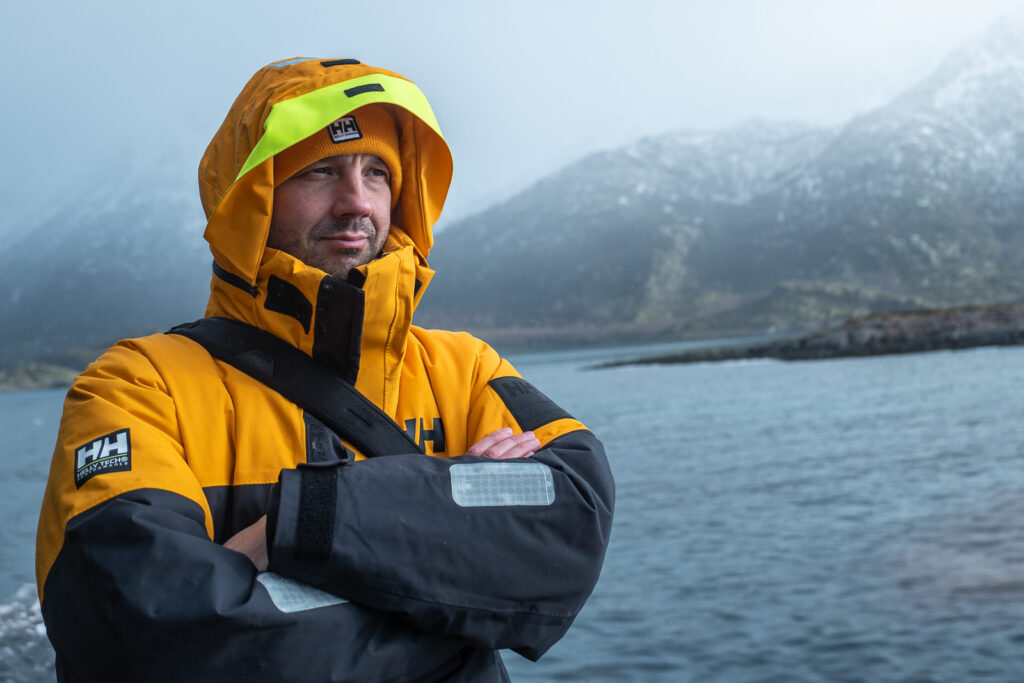
I use positive reminiscence, which is something I learned when I was practicing high-altitude outdoor photography professionally.
For years, I’ve photographed a lot in the mountains and have published mountaineering and alpine photography in National Geographic, Outside, and The New York Times.
When I face uncertainty, I get anxious. To address it, I tap into positive memories from being on the mountain, when I’ve been exposed on a ridge or somewhere high up in a helicopter. I survived that! Thus, I shouldn’t be so stressed because an investor said “no” or “not yet.”
I’m also obsessed with details. I love to have a plan within a plan. You cannot avoid uncertainty, but you can cope with it. It’s like a map that is constantly changing. Your best hope is to take the step, take a deep breath, and embrace the complexity. Convince yourself you can do it. It’s imperative to improvise honestly in situations when there’s uncertainty.
What do you view is the most important step for building an enduring company?
Kamil: Having passionate and excited people that you can take on the journey with you. And whenever you hire new people going the extra mile to bring them along.
This is also applicable to existing shareholders and new stakeholders. I’m still practicing this art, still learning. I’m being coached by my chairman and mentor because it’s easy to pretend you know better. When you pretend you know better, usually you can’t take people on the journey.
Also, it has to be the right mix of putting your ego aside and pausing to reflect. When somebody doesn’t understand something, and it’s easy to get annoyed, I think of my five-year-old son. I cannot be frustrated with my five-year-old when he doesn’t want to do something, he just doesn’t understand it. I have to make an effort and take him on the journey.
Take people on the journey and tell them that if it pans out, we will do our best to make patients healthy, the team rich, and make it fun. If we achieve all three, people are gonna come for more. That is most important in my industry, where things fail 97 percent of the time.
If you fail, it’s because of science, not execution or ego. Some of the best in this industry failed not because they were jerks. Science defeated them. This is acceptable to them and their investors because they know how big of a challenge they face, primarily if they work on innovative and complex problems. But if you lost people along the journey because of your ego or sick ambitions or aggressiveness, you’re done.
How are you thinking about global expansion?
Kamil: I live and work in Bellinzona, Switzerland, a very rapidly emerging hub of biotechnological innovation in Switzerland. Although Europe has a lot to offer, as access to capital, innovation, and risk taking, is not on par with the progress that is made in America. Hence, the natural direction of expansion for my company is building the bridge between Swiss innovation and the American appetite for risk and innovation.
It’s not just about capital; that’s the easy part. It’s about the mindset. It’s about embracing thinking big and being able to explicate your view and vision to others who will not ridicule you and call you a megalomaniac or crazy person. You’re often going to get this scrutiny in Europe. I’m not trying to slash Europe; it’s not the best place to think big right now.
What has been your most memorable moment from your partnership with Hoxton Ventures?
Kamil: Kevin Martelli, one of our angel investors and first believers, introduced me to Hussein. After a half-hour conversation, I was blown away by his candor. I had already spoken to quite a few investors with moderate success. Granted, I’ve learned a lesson or two.
What made me believe that Hussein is an exceptional person is his ability, in a quick and unobtrusive way, to extricate the process and next steps. And initially, to my surprise, go through this process exactly as described for the right outcome. It is remarkable.
There is no b.s. When he was considering investing, Hussein told me, “I’m going to call a few people who have conflicting opinions about you and your company, but at the end of the day, I’m making the decision.” I was like, thank you. No secret handshakes. And he literally delivered on that.
There are many people you have to chase, and you have to fight for it. I don’t hold that against anybody. VCs are human. Founders are human. We all have good and bad days, sometimes horrible weeks. Hussein has been remarkably consistent. He never promises something he would never deliver. He’s sincere. I value this above every other quality.
Any advice for founders raising capital right now?
Kamil: Sleep well, stay strong. I know, it does sound almost like preparing for Desert Storm.
Listen carefully to feedback from the market. Every venture capitalist has a particular recognition pattern. I’ve learned that the more work you do for them, the easier the process of getting an investment, whether it’s through due diligence, well-prepared materials, or a great deck.
Leveraging your board and executive chairman to help you with the investment process is key. Do not pretend you can do it all; you just can’t, especially in this funding environment and in biotech, which is still recovering slowly from a recent slump. Even with good data, differentiated technology, and a great team, we see some colleagues go through tough times. You have to stay strong and obsessively, religiously believe that you will make it. I do, and so does my team.